


















Rank Your Business in Surrounding Cities
If you run an HVAC, plumbing, or electrical company, you already know the painful reality of the Service Area Business (SAB) model. Your trucks are on the road all day, crossing county lines and solving problems inside homes across five different cities.
Yet, when you check Google Maps, your online visibility drops off a cliff the moment you look outside the immediate radius of your physical shop.
It feels deeply unfair. Your physical address is holding your business back, and the local market can feel like an uphill battle.
How Contractors Can Actually Rank in Surrounding Cities
At LeadsNearby, we look at this challenge through a realistic lens: Being #1 is great. Being everywhere is better. We’ve spent years helping home service contractors navigate Google’s algorithms, and we see the exact same location-based hurdles surface constantly.
To win in surrounding cities, you have to separate local SEO myths from technical realities and deploy strategies built around what Google actually values.
Myth vs. Reality: What Google Actually Says About Proximity
Before fixing your visibility, you must discard the bad advice circulating in Facebook groups and contractor forums. Let’s look at the actual rules of engagement according to Google’s documentation:
The Service Area Radius Myth
-
The Myth: “If I log into my Google Business Profile (GBP) and expand my service area radius to 50 miles, Google will rank me 50 miles away.”
-
Google’s official guidelines state that defining your service area merely informs users where you drive; it has zero impact on your actual ranking algorithms. Google determines your local map pack ranking based on three immutable pillars: Relevance, Distance, and Prominence. Adjusting your service area settings does not change your distance calculation.
The Programmatic City Page Myth
-
The Myth: “I can build 30 identical city pages, swap out the city names in the headers, and dominate the organic search results across the entire region.”
-
The Google Reality: Google’s helpful content system explicitly flags and penalizes low-effort, duplicate doorway pages. If your city pages offer no real, localized value or first-hand experience (E-E-A-T), Google will filter them out of search results entirely.
What valuable insights can you provide your marketing company about the local cities where you want to win more business? If your answer is “not much,” that may explain why your results are falling short.
The contractors who dominate their local markets share real knowledge about the communities they serve like neighborhoods, landmarks, customer needs, seasonal challenges, and local trends. They also provide photos of their trucks in the neighborhoods that they want business from.
The more unique expertise and local insight you contribute, the more authentic, relevant, and effective your marketing becomes. Give your marketing team nothing to work with, and don’t be surprised when your results look just like everyone else’s.
Challenge 1: Your Shop is Located Just Outside the Google Maps City Border
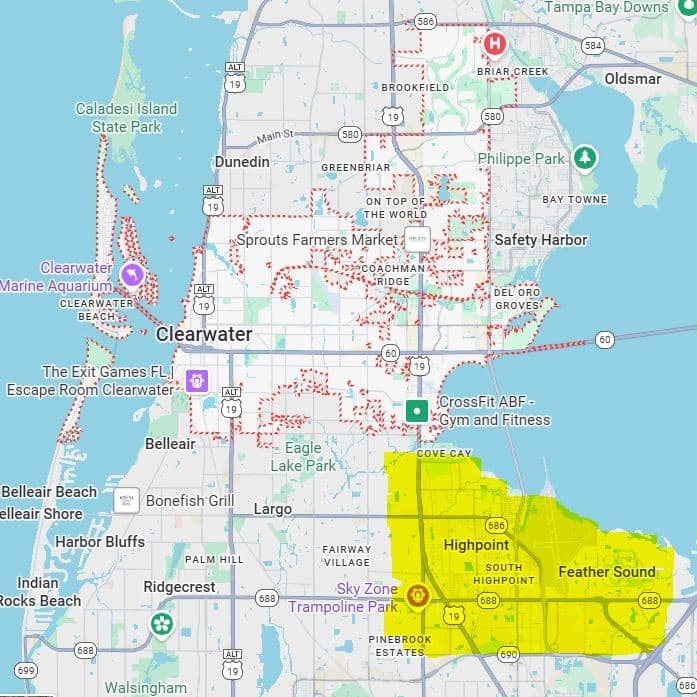
Look up your city on Google Maps, and you will see a red, dotted perimeter delineating the city limits that Google believes. Even if you have an address that says your city, it doesn’t mean Google thinks your adress is located in that city.
If your shop is located even 500 feet outside that line, Google’s distance algorithm will heavily favor a competitor inside the border for core keywords like “plumber in city.”
And it doesn’t matter if your mailing address, ZIP code, or local Post Office tells a different story. Google doesn’t determine local rankings based on how the Post Office defines service areas.
Instead, Google relies on its own geographic understanding of city boundaries when deciding which businesses are relevant for city-specific searches. Understanding Google’s map data and city definitions is far more important than relying on postal boundaries when developing a local SEO strategy.
Most Contractors Miss This Critical Local SEO Detail
It’s also important to understand that Google treats these as two completely different search intents:
- Plumber {City modifer}
- Plumber Near Me
When a homeowner searches using a city modifier, Google typically prioritizes businesses that are most relevant to that specific city. In the map example above unless you are located within the red dots on the Google Map, you won’t rank for that search in the map results.
However, when someone searches without a city modifier and uses a phrase like “near me,” Google’s results are heavily influenced by the searcher’s physical location, which is determined by factors such as their device location and IP address.
In other words, the businesses that appear for a “near me” search may be very different from those shown for a city-based search. If your business is physically located “near them” you can show up in the Map results.
The LeadsNearby Playbook
1. Establish a Specialized Competitive Advantage
If you compete head-to-head for generic terms from outside the border, you will lose on distance. To counter this, optimize your website and GBP categories for highly specific, high-ticket services that city-center competitors ignore.
If ten HVAC companies inside the border focus on standard AC repair service, optimize your surrounding city strategy around geothermal heat pump design or ductless multi-split systems in historic homes. When a user searches for a rare, specialized service, Google automatically widens its geographic search radius, pulling your business into the local pack from outside the border.
2. Capitalize on Live Availability
Your business being open at the exact time of a user’s search is a powerful local pack ranking signal. While major city franchises rely on answering services that route calls to voicemail after 5:00 PM, an electrical or plumbing contractor offering true 24/7 live dispatch will experience an automatic visibility spike during off-hours, bypassing the physical distance penalty.
3. Deploy Local Services Ads (LSAs)
When organic proximity fails, use Google’s ad architecture to force your way in. For trade contractors, Google Local Services Ads (LSAs) are the ultimate equalizer. Because LSAs allow you to pay per lead rather than per click and operate based on targeted cities and zip codes rather than your physical office coordinates, you can compete directly with businesses in the heart of the city.
These LSAs also appear at the very top of the search results, often before any organic listings.
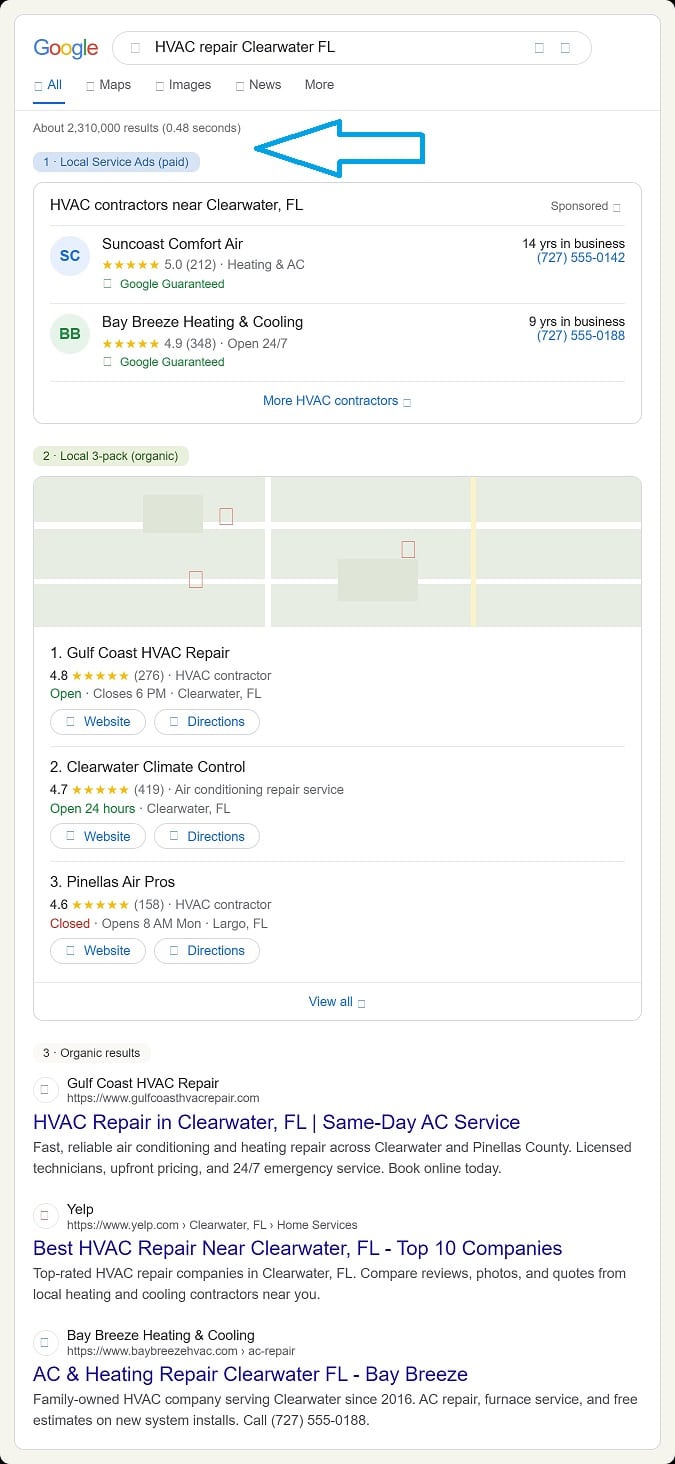
Many homeowners don’t immediately recognize they’re looking at an advertisement. They simply see the first company Google presents and click. When your business occupies that prime position, you gain a significant advantage by capturing attention before prospects even consider your competitors.
Challenge 2: The Target City is Dominated by Massive Corporate Franchises
You want to move into a neighboring market, but it is already locked down by multi-location private equity-backed home service giants with 5,000+ reviews on Google.
You cannot out-volume these corporate brands overnight, but you can out-maneuver them on quality. Google’s local ranking factors place massive weight on review recency, sustained velocity, and sentiment analysis, not just the total lifetime review count.
The LeadsNearby Playbook:
-
Expose the Customer Service Gap: Corporate franchises often let customer service standards slide, resulting in high volumes of old reviews but low overall star ratings (e.g., 4.1 or 4.2 stars). A local, independent contractor maintaining a sharp 4.9-star average will consistently win the click from discerning homeowners who sort reviews by Newest.
-
Gather First-Hand Expertise Reviews: Train your technicians to ask for specific reviews that showcase E-E-A-T. A review that says, “John came out and fixed our AC” does very little for SEO. A review that reads, “John from [Company Name] arrived in [Target City] and cleared our clogged drain line using a hydro-jetter” provides Google’s semantic AI with the exact entity and geographic proof needed to boost your rankings in that area.
Ready to Turn Your Trucks Into Ranking Signals?
Your physical address shouldn’t be a ceiling on your revenue. If your teams are already driving to surrounding cities and doing the work, it’s time to make sure Google actually recognizes it.
At LeadsNearby, we don’t rely on local SEO myths, outdated radius tricks, or generic doorway pages. We build data-driven, entity-rich local marketing strategies that match the real-world footprint of your fleet, proving to Google’s algorithms exactly where your business operates every single day.
Stop letting a red line on a map dictate your growth.
Call LeadsNearby at 919-758-8420 and schedule your FREE Local Footprint Audit and let’s start mapping out your plan to dominate every city you service. Or contact us online with any questions.
Related Marketing Articles
Why Home Service Contractor Expertise Wins Over Keywords Today
Evidence Backed AI Optimization for Home Service Contractors
« How To Optimize GBP for Home Service Contractors