












Why Your Yelp Reviews Keep Vanishing
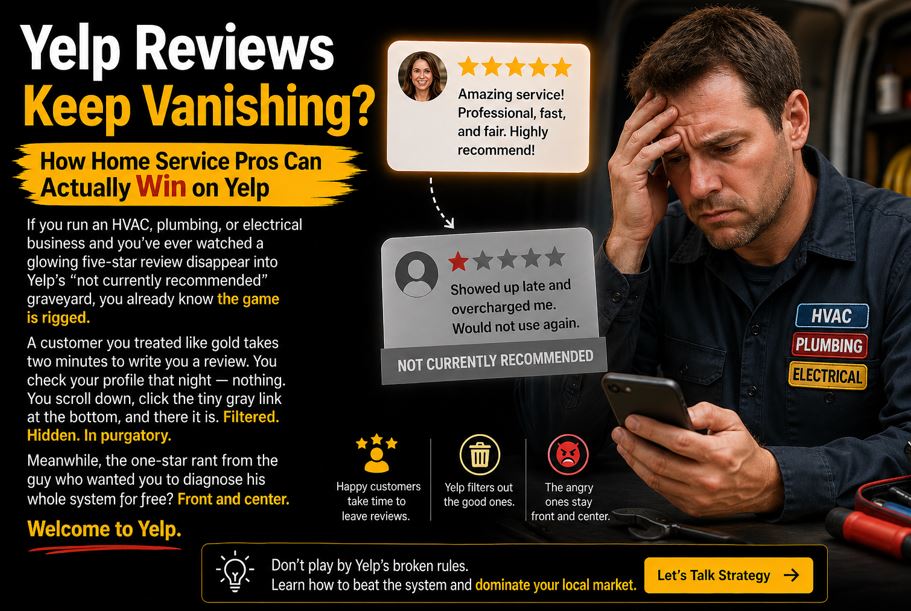
How Home Service Contractor Pros Can Actually Win on Yelp
If you run an HVAC, plumbing, or electrical business and you’ve ever watched a glowing five-star review disappear into Yelp’s “not currently recommended” graveyard, you already know the game is rigged.
A customer you treated like gold takes two minutes to write you a review. You check your profile that night — nothing. You scroll down, click the tiny gray link at the bottom, and there it is. Filtered. Hidden. In purgatory.
Meanwhile, the one-star rant from the guy who wanted you to diagnose his whole system for free? Front and center.
Welcome to Yelp.
The Part Yelp Won’t Tell You
Yelp insists its filter is unbiased. Yelp insists advertisers get no preferential treatment. And Yelp has a lot to say about why you should trust the process.
In our experience working with home service contractor companies around the country, the pattern is hard to ignore:
- Non-advertisers watch their positive reviews vanish.
- Advertisers don’t seem to have that problem nearly as often.
Draw your own conclusions.
The filter isn’t totally random, though. It flags reviews from accounts the algorithm considers “inauthentic” — which, unfortunately, describes most of your actual customers.
- A homeowner who created a Yelp account just to praise your tech? Filtered.
- A reviewer with no profile photo and only one review? Filtered.
- Someone writing from the same IP address as another recent reviewer (say, a couple in the same house)? Almost always filtered.
Here’s the kicker nobody mentions: Yelp’s own terms of service technically prohibit businesses from asking for reviews at all.
So the whole system is built on a contradiction — reviews need to look spontaneous, you can’t ask for them, but you also need them to compete.
That’s why the approach matters.
Rule #1: Not Every Customer Should Be Asked for a Yelp Review
This is the single biggest mistake we see. A business owner tells every happy customer, “Hey, would you mind leaving us a Yelp review?” Nine out of ten of those reviews end up filtered, because nine out of ten of those customers aren’t real Yelpers.
Before you even consider asking, figure out whether the person is active on the platform. Do they check in at places? Do they have reviews scattered around town? Is their profile filled out with a real photo?
One trick that works surprisingly well for HVAC and plumbing crews: have the tech casually ask the homeowner if they’d snap a photo of them working — “my boss likes to see the team in action” usually does the trick.
Customers who immediately say “sure, I’ll post it on Yelp!” just outed themselves as active Yelpers. Those are your people.
Anyone else? Send them to Google. That’s where reviews from normal humans actually stick.
Rule #2: Yelp Leads Are a Different Animal
If someone found you through Yelp and is calling to schedule, treat that call differently from the very start.
Active Yelpers often use the platform as leverage. Some are wonderful, loyal customers. Others see Yelp as their personal negotiation tool. They’ll mention the review early. They’ll push on price. They’ll expect extras. In their heads, they’re “getting the best deal.” In reality, they’re letting you know what happens if you don’t play along.
Handle it from the first phone call. Set expectations clearly. Be warm but firm on pricing. And when the job is done and they’re happy, do not send them a review link. Seriously. Don’t.
Instead, try something like: “We really appreciate you finding us on Yelp — if you ever have a minute to hop back on there, it would mean the world.” That’s it.
Let them do it on their own, on their own device, from their own account. Organic reviews from established Yelpers don’t get filtered nearly as often. Solicited ones almost always do.
Rule #3: Be Careful About Advertising on Yelp
Yelp’s sales team is relentless. They’ll suggest advertising somehow “unlocks” your reviews (which, again, isn’t supposed to be a thing, right?). They’ll pitch you on traffic. They’ll offer “free” credits that mysteriously renew on their own.
For most home service businesses outside major West Coast metros, the math just doesn’t work. Yelp usage varies wildly by region.
- In San Francisco, LA, Seattle, or New York, you might see real lead volume.
- In most of the Southeast, Midwest, and mountain states, you’ll pay for clicks that never convert.
If you do decide to advertise, track every lead with a dedicated call tracking number. Give it sixty days. If the cost per actual booked job is ugly — and it usually is — walk away.
Don’t let a rep talk you into “just one more quarter.”
Rule #4: Keep Your Profile Updated (But Brace Yourself)
A fully up-to-date Yelp profile — accurate hours, service areas, photos, categories, response rate — performs better.
It also means the sales calls will start. Every edit you make seems to trigger another round of outreach from a different rep. It’s still worth the hassle. A neglected profile looks neglected, and Yelp’s algorithm notices.
Review velocity — how many positive reviews you gain over time — matters. So does profile completeness.
Which brings up something most business owners haven’t caught onto yet.
Rule #5: AI Is Pulling From Yelp More Than You Realize
Ask ChatGPT or Perplexity to recommend a plumber in your city. Go ahead, try it. There’s a good chance Yelp shows up in the answer — as a source, as a ranked list, or as a direct mention of specific businesses.
AI search tools trust structured, rated directories because they’re easy to parse. Yelp, Google, BBB, Angi — these show up constantly in AI-generated answers. If your Yelp profile is thin, outdated, or drowning in filtered reviews, you’re invisible in that layer of search. And that layer is growing fast.
Keeping a handful of visible positive reviews, current photos, and accurate info isn’t really about Yelp anymore. It’s about being findable when a homeowner asks an AI which HVAC company to call.
A Few More Things Worth Doing
Respond to reviews — including the filtered ones.
Yes, you can respond to reviews sitting in the “not recommended” section. A calm, professional reply to a negative review (or even a filtered positive one) is visible to anyone who clicks through. The prospects who dig that deep are the ones closest to calling. Don’t waste that moment.
Flag fake reviews with documentation.
If a competitor or someone who was never a customer leaves a review, Yelp’s reporting process is clunky but it occasionally works. Screenshot everything. Be specific in your report. Keep records.
Diversify — please.
Google Business Profile does more for nearly every home service business in this country than Yelp ever will. Pair it with a couple of industry-specific platforms and you’ll be in better shape than the competitor obsessing over his Yelp stars.
Need Help with Yelp?
Yelp isn’t evil. It’s just built for a use case that doesn’t particularly favor small home service businesses, and its revenue model rewards the companies writing the biggest checks. You don’t have to play every round of that game.
- Know the rules.
- Ask the right customers.
- Handle Yelp leads with care.
- Spend your marketing dollars where they actually come back to you.
The good reviews are out there. You just have to be smart about who leaves them.
Call LeadsNearby at 919-758-8420 for additional help or contact us online with any questions about your digital markeing opportunities.
The Home Service Contractor Guide to Conversions » « How Contextual Reviews are Rewriting the Rules of AI Search